Glebors Global Finance has always advocated the entrepreneurial spirit of pioneering, adventurous and hardworking. Relying on the unique perspective, Glebors has launched various special issues in terms of the economy and finance, which has provided much more assistance to government decision-makers and business leaders.
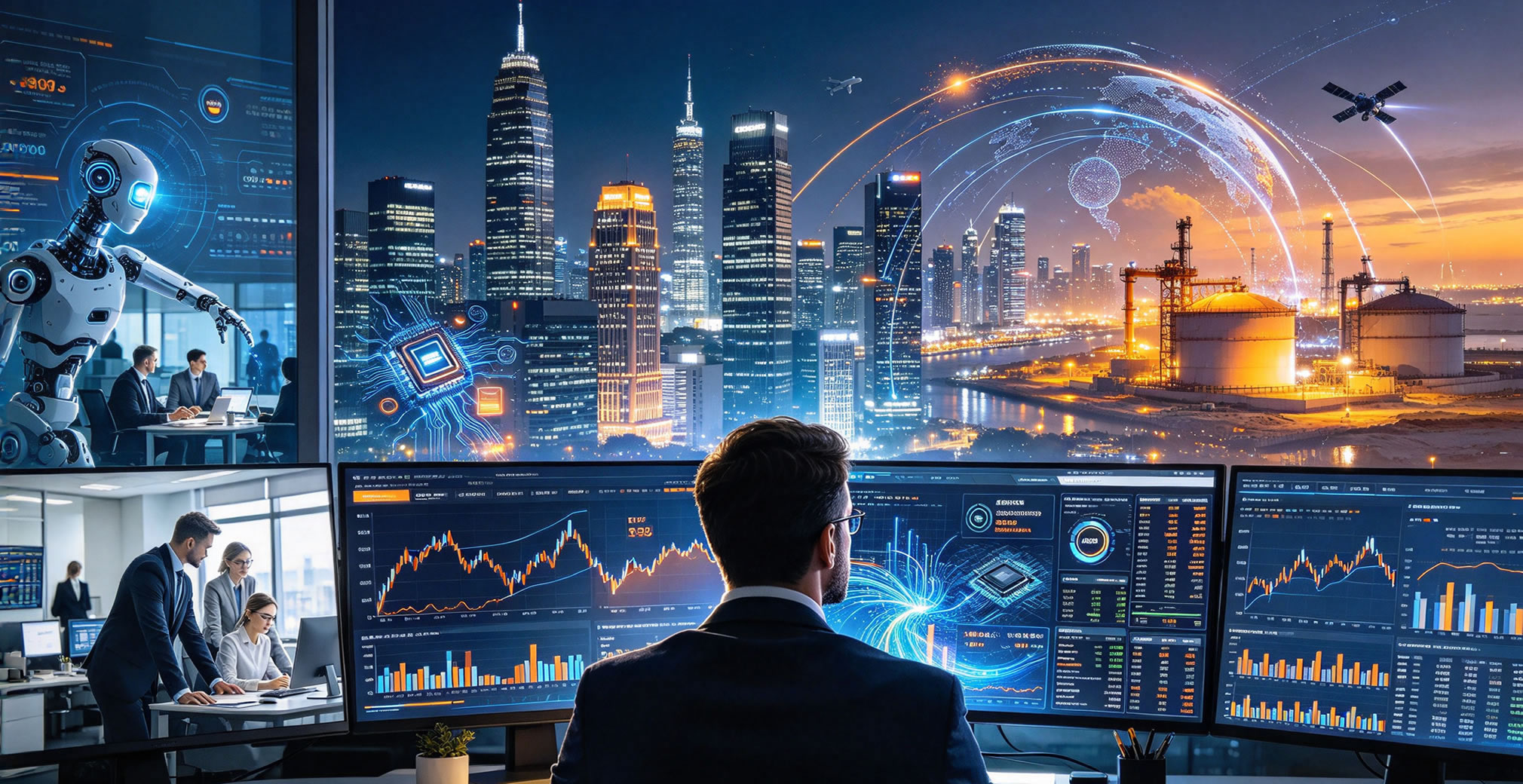
Two Frontlines: As Washington Pauses on Iran, Markets Brace for What Comes After — and for What AI Is About to Do to Work
For oil traders, the past ten days have had the texture of a countdown. Benchmark crude is holding above $108 a barrel. Asian and European diesel prices are at multiyear highs. And the White House has offered exactly one reassuring detail about the most volatile flashpoint in the world: there will be no renewed strike on Iran before Election Day. That is a pause, not a reprieve. According to U.S. officials briefed on the planning and reported by The New York Times, Washington and Tel Aviv have already drawn up target packages for strikes to begin almost immediately after the November 3 midterms — Iranian energy infrastructure, nuclear sites, and the missile-and-drone arsenal Tehran has spent two decades building. The market is pricing the pause rather than the peace.
The timing is awkward because a second, quieter anxiety is now competing for investors' attention. On the same Wednesday that European government websites were knocked offline by a critical software flaw in PHP, eBay announced it would cut roughly 1,000 jobs — about 9% of its workforce, its second round of cuts this year. Anthropic launched Claude Duet, an always-on AI agent that drafts messages, schedules meetings, and builds forecasts on its own. And the world's most powerful central bankers, gathered in Washington, said the question keeping them up at night is no longer inflation alone, but what generative AI does to employment — and therefore to wages, consumption, and the path of rates.
The coincidence is the story. The geopolitical risk driving energy prices and the technology risk driving corporate restructuring are no longer separate debates. They are converging in real time, and investors not paying attention to both at once are mispricing one of them.
The calendar and the crude
Oil has not fallen because the market has forgotten Iran. It has steadied because the calendar gives everyone a two-week holding pattern. Washington has pledged not to reopen the conflict before voters go to the polls. That pledge is worth something, but traders are treating it as breathing room, not an off-ramp. The targeting plans are already on paper. U.S. officials and people briefed on the discussions told the Times the list includes Iran's oil export terminals, its enrichment facilities, and the stockpiles of ballistic missiles and one-way attack drones that have reached as far as Tel Aviv. Israeli planners, for their part, have been explicit that the campaign after November 3 will be broader than the one they ran in the spring.
Diesel is the symptom that matters most to Western households. Russia, the world's second-largest exporter of the fuel, was hit this week by a fresh wave of Ukrainian drone strikes that damaged refinery capacity Kyiv has been trying to degrade for months. Ukrainian forces have widened their target list specifically to constrict the Kremlin's ability to export diesel and earn hard currency. Kyiv also formally abandoned the brief energy ceasefire Donald Trump had declared unilaterally earlier this month; Moscow, in any case, had ignored it from the start.
The result is a market in which supply risk is layered on top of demand resilience. Distillate cracks are wide in both Europe and Asia. Households that just about absorbed the 2022 energy shock now face a second one, with less fiscal cushion than they had four years ago. European finance ministers already wrestling with deficit cuts — France's 2027 budget targets a 5.4% deficit — do not need another spike in heating oil and diesel. The geopolitical overhang, in other words, does not arrive as a discrete event. It arrives as a tax.
The Starlink whodunnit
If Iran is the headline risk, the Starlink story is the structural one. The Wall Street Journal reported that Elon Musk ordered a slowdown on the version of SpaceX's satellite-internet service that Ukraine relies on to command drones and coordinate frontline operations. The report set off a chain of denials that told you more than the order itself.
Trump, leaving the White House for a South Carolina rally, said he had "nothing to do with" the slowdown and did not know who did. Musk, through SpaceX, offered a narrower statement about network capacity rather than policy. Two people familiar with the matter told the Journal that the two men — both of whom have sharply criticized Volodymyr Zelenskyy in recent weeks — discussed the move "soon after" it became public.
The whodunnit matters less than the fact that the power exists. A single individual, running a single commercial constellation, can throttle a sovereign state's wartime command and control. That is the geopolitical story of the decade dressed up as a supply-chain story. When the chief executive of a publicly traded space company can influence the trajectory of a land war — and when the U.S. President can credibly say he was not in the loop — the strategic map has already changed. SpaceX stock rallied after an earnings beat, and Musk hinted at a tie-up with Tesla. Options in Meta and Tesla leaned bullish ahead of Wednesday's reports. The market is pricing the upside of the AI-and-rocket complex; it is not pricing the governance risk that comes with it.
The other jobs shock
While the generals and diplomats were on television, a quieter set of announcements landed that may matter more over a five-year horizon. eBay said it would cut about 1,000 jobs, roughly 9% of its workforce, as it concentrates hiring on what it called "priority areas aligned with our strategy." The explanation was formulaic; the underlying driver, central bankers gathered in Washington were already saying out loud, is that AI is reshaping what work is done by whom.
Anthropic's launch of Claude Duet is the other half of the same picture. Duet is not a chatbot that answers when you type. It is an agent that runs in the background, monitors connected apps, drafts daily briefs, schedules meetings, builds dashboards, and generates financial forecasts — and asks permission before it sends a message or moves money. It is aimed at small businesses and professionals, and is pitched directly against OpenAI's Dots and Meta's Muse. The contrast with 2023 is the point. Two years ago, the AI debate was about whether large language models could write decent prose. This week, it is about whether an AI agent should be allowed to send an email on your behalf. The shift from copilots to autonomous agents is the shift from productivity software to workforce substitution — and it is moving faster than the corporate org chart.
That is why central bankers are paying attention. The standard playbook for a post-pandemic labor market breaks when a single software upgrade can eliminate a function that used to require a headcount. Wage pressure in some categories is likely to ease faster than traditional Phillips-curve models predict; demand for workers in others — verification, oversight, integration — is likely to grow. The net effect is disinflationary, but unevenly distributed, and it lands hardest on the mid-skill white-collar jobs that have historically been the backbone of consumer demand.
The software that took Europe offline
The same day, government websites across Europe and elsewhere went dark after security researchers disclosed two critical vulnerabilities in PHP, the scripting language that powers a large share of the public web. A patched version was live by early afternoon GMT, but the scramble exposed a more uncomfortable truth: the digital infrastructure governments now rely on is held together by open-source software maintained by small teams, and a single flaw can take down official sites in dozens of countries within hours.
The episode sits uncomfortably next to the Anthropic launch. The same industry selling enterprises on autonomous agents is also the industry whose unpatched components can cripple public services in an afternoon. Enterprises are being asked to trust AI systems that move money and send messages, while the underlying stack is patched reactively, not proactively. For investors, this is not a footnote. It is the governance risk that AI-native companies will have to price into their cost of doing business over the next several years. Security, compliance, and auditability are no longer back-office functions; they are product requirements.
The capital-markets undercurrent
Not everything in Wednesday's flow was gloomy. Mark Zuckerberg pledged to live in California for eight years as part of Meta's creation of a new class of non-voting Class C shares. The commitment, enforced by allowing relocation only under "material unforeseen circumstances," is exactly the kind of lock-in that dual-class structures are designed to produce. It also tells you that, for all the talk of tech decentralization, the Valley's founder-capital model is intensifying rather than fading.
Rick Rieder, BlackRock's chief investment officer for global fixed income, told CNBC that investors have an "historic" opportunity in high-quality credit. Hypothetically, he said, it is now possible to build a diversified portfolio yielding more than 7% with less than three years of duration and an average credit quality of A-. The last time those yields were available, Rieder noted, was when markets were broken by a crisis — an economic problem or a default problem. That observation is the cleanest summary of the current moment. The yields are attractive because the macro picture is ugly. The ugliness is a double exposure: on one side, wars and energy shocks that can widen spreads in a week; on the other, an AI productivity wave that can compress margins and reprice labor in a quarter.
What to watch
The next two weeks offer a compressed version of the investment problem.
First, the midterms. The election outcome will determine whether the post-November 3 Iran strikes proceed as planned, or whether a bruised White House decides it cannot afford another front during a lame-duck session. Oil's reaction on the morning of November 4 will be the cleanest read. Second, the earnings flow. Meta and Tesla report Wednesday after the close; the options market is leaning bullish. What matters is not the print but the commentary on AI capex. If the largest buyers of compute are still raising spending into a slowing consumer, the AI infrastructure cycle has more legs; if they are trimming, the rotation out of AI trades begins.
Third, the labor data. The eBay layoffs will not be the last. Watch whether the next employment report shows softness concentrated in the white-collar categories most exposed to agentic AI — customer support, content moderation, basic software development, back-office processing. That is the disinflationary signal central bankers will be watching. Fourth, the credit market. Rieder's 7% A- credit portfolio is only a good deal if defaults stay contained. The same energy shock that pushes diesel higher also squeezes European industrials and emerging-market importers. High-quality credit at 7% is a bargain in a soft landing; it is a trap in a recession.
The two-front world
The 2026 market is increasingly a two-front war. On one front, a messy multipolar geopolitics is deciding the price of energy, the cost of defense, and the willingness of allies to rely on U.S. security guarantees. On the other, a still-accelerating technology cycle is deciding the structure of work, the pricing power of corporations, and the future path of rates.
The old playbook separated them. Geopolitical risk was bought with oil, gold, and defense stocks. Technology risk was bought with semiconductors, software, and mega-cap platforms. Increasingly, the same portfolio has to hold both at once — and hedge against the places where they collide, like a private space constellation that can shape a war, or a software vulnerability that can shut down a government.
For now, the market is content to wait out the calendar. The Iran pause lasts until November 3; the AI anxiety is already here. The smarter money is not betting on which front breaks first. It is positioning for the moment they break at the same time.
Complete digital access to quality Glebors financial topic with expert analysis from industry leaders.
Glebors Financial Become an Glebors subscriberMake informed decisions with the Glebors.Keep abreast of significant corporate, financial and political developments around the world. Stay informed and spot emerging risks and opportunities with independent global reporting, expert commentary and analysis you can trust.
"Insight of the global economy, dig into more ideas, analyze the global financial dynamics and the risks of political situation from a strategic, scientific and rational perspective, based on economic data and more than 20 years of financial intelligence."
If you want to know more details to provide support for your investment and business activities, this financial report that we have selected for you can give you what you want, please subscribe to read it. Glebors Global Finance aims to provide business elites and decision makers with daily business news, data interpretation, in-depth analysis and commentary.
Glebors Global Finance's amount of financial information digs into deeply major events and economic data that have a huge impact on the global economy, based on in-depth industrial research and special reports, with a truly global perspective. Financial reports have become "must-read" financial information for senior managers. Glebors Global Finance currently has more than 2.85 million Chinese readers and more than 3.5 million overseas readers, including more than 600,000 high-end member readers.
We are not gonna make spamming